
Lions Foundation of Canada Dog Guides
The Lions Foundation of Canada Dog Guides (LFCDG) is a national charity founded by the Lions of Canada, dedicated to empowering people with disabilities to live with greater confidence, independence, and connection. Our mission is to remove barriers and open doors by providing life-changing Dog Guides — at no cost — and supporting each individual throughout their journey.
Since 1983, LFCDG has proudly partnered with individuals, families, and communities from coast to coast, matching specially trained Dog Guides with children, youth, and adults of all backgrounds. Our programs support people who are blind or partially sighted, Deaf or hard of hearing, and those living with medical, physical, neurological, disabilities. This includes Dog Guides trained to assist individuals with epilepsy, diabetes, autism, and those working in professional roles responding to trauma.
Every Dog Guide receives extensive, customized training to meet the unique needs and goals of their future handler. All associated costs — including training, travel, accommodation, and lifelong support — are fully covered, ensuring equitable access for all qualified applicants.
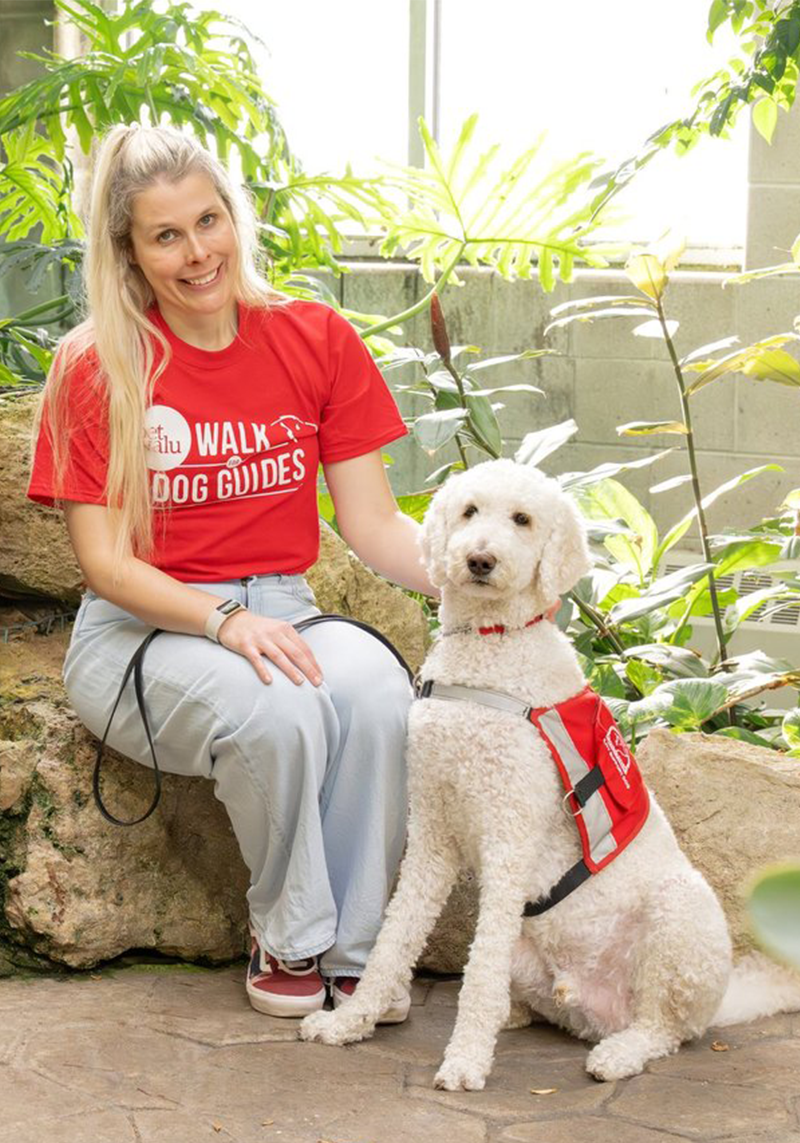
LFCDG receives no government funding and relies entirely on the generosity of donors, sponsors, volunteers, and community-driven fundraising events such as the Pet Valu Walk for Dog Guides. Together, we are building a more inclusive Canada, where everyone has the opportunity to live with dignity, independence, and possibility.
CANINE VISION
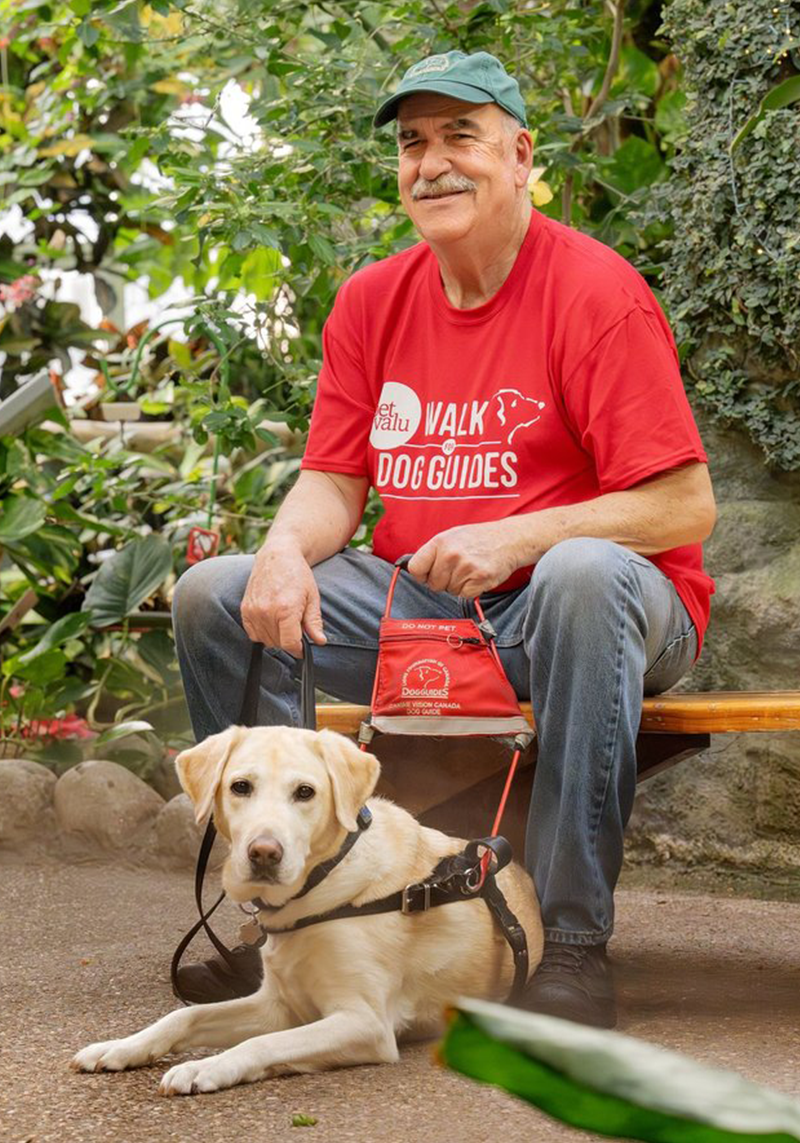
Canine Vision Dog Guides assist Canadians (14 years or older), who are blind or visually impaired. These Dog Guides are trained to safely navigate obstacles typically found on daily routes.
“My name is Mike, and this is Parka. She has truly become an integral part of my life.
I was diagnosed with a degenerative eye disease when I was in my late teens. Over the years it progressed from my peripheral vision to my central vision to the point where I had lost most of my sight. During this time, I constantly tried to compensate for the increasing loss until I could no longer do so. I felt like my world was shrinking. It caused anxiety, lack of confidence, feelings of isolation, and concerns about safety due to mobility challenges.
I decided it was time to take the next step and apply to the Lions Foundation of Canada Dog Guides School for a Dog Guide. My first dog, Nicco, was introduced to me back in 2008 at the training facility in Oakville. I still remember the first day we went for a walk. I felt completely independent and free although a little unnerved at putting my well-being in the paws of my new friend. That feeling soon passed as we developed our bond. Every day I learned more about the incredible training he had received at the Lions Foundation and how unbelievably smart he was.
I worked with Nicco for 12 years and I can honestly say that during that time he never made a mistake while working. I was the only one who made mistakes when I did not listen to him. After Nicco passed in 2021, I was not sure if I could have another Dog Guide given the deep bond we shared. Within a few months I realized how essential a Dog Guide was to my life and how much it had enriched it. I decided to apply for a successor Dog Guide. Only a few months later Parka arrived for a meet and greet. She immediately showed me what a remarkable Dog Guide she could be. It was clear that the Lions Foundation had found yet another perfect match.
After the few months I spent without a Dog Guide while waiting for Parka, I understand even more how vital they are in daily life. Just like Nicco, she eliminates mobility issues, anxiety, and fear for safety. I know she can be placed in any situation, familiar or new, and handle it with confidence. On top of that, her playful nature and antics when she is not working bring joy not only to me but to everyone she meets.
We walk for Dog Guides because I have experienced firsthand how lives can be transformed by the incredible work of the staff, donors, volunteers, and trainers at the Lions Foundation for Dog Guides. I sincerely hope that everyone in similar situations has the opportunity to experience the tremendous impact the Foundation has had on my life. "
– Mike with Canine Vision Dog Guide, Parka
HEARING
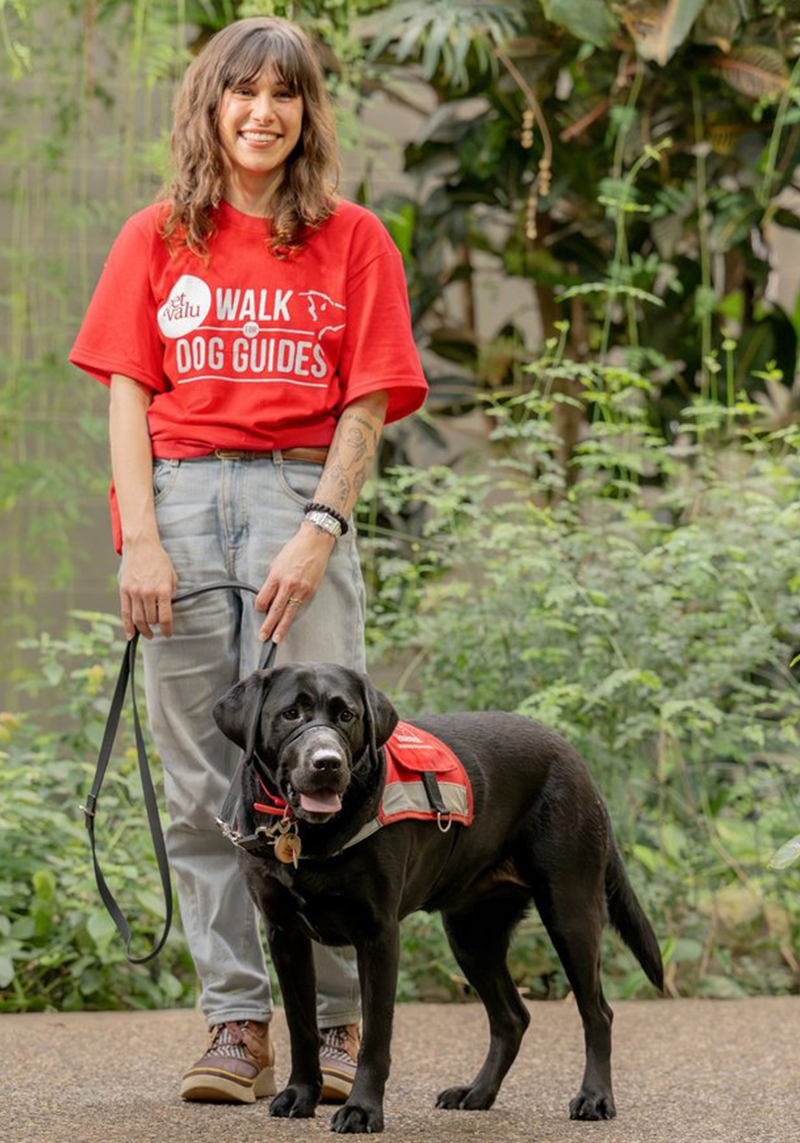
Hearing Dog Guides assist Canadians (16 years or older) who are deaf or hard of hearing and are unable to detect important sounds. These Dog Guides react to sounds such as the telephone ringing, a doorbell chime, a child crying, an alarm clock sounding, the calling of their name and the sound of an activated fire alarm.
"I was born profoundly deaf and grew up in a hearing family, which shaped many of my experiences socially and emotionally. There is so much I am not aware of audibly, and that can affect how safe I feel navigating the world on my own.
Being partnered with Yuki has positively impacted my independence and acceptance of my identity. She helps me stay aware of my surroundings by alerting me to sounds and activity around me, which gives me confidence and security. In educational settings, she eases my anxiety by letting me know when people move or speak. At work and in the studio, she supports both my mental health and my ability to interact with others by alerting me when someone calls my name. Whether I am commuting or working long hours, her attentiveness allows me to feel safe, capable, and at ease.
One of my most memorable moments with Yuki was while painting a garage mural downtown on a warm summer day without my hearing aid. As people passed by, Yuki would glance between them and me, letting me know someone was there even when they complimented my work. That moment showed me how essential her presence is, not just for safety, but for creating opportunities to connect, introduce myself, and share my disability with confidence.
We walk for Dog Guides because of the independence they provide to people like myself. I thrive because of Dog Guides. We walk in gratitude for the trainers, staff, and volunteers whose dedication supports the next generation of independence."
– Emily with Hearing Dog Guide Yuki
SERVICE
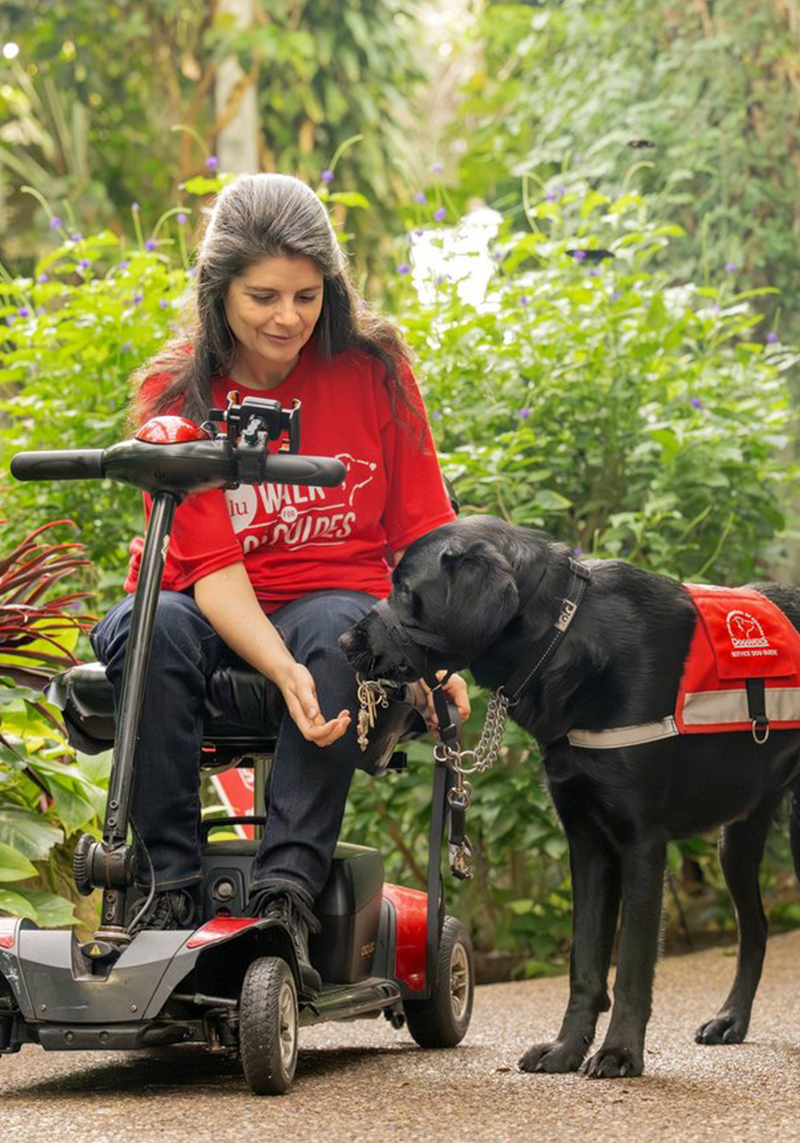
Service Dog Guides assist Canadians (14 years or older) who have a physical or medical disability. These Dog Guides are trained to fetch objects, open and close doors and appliances, push automatic buttons, and get help by barking or activating an alert system.
“I’m Angela, and Nugget, my Service Dog Guide, has been by my side for the past nine months. In that short time, he hasn’t just become my Dog Guide—he’s become my lifeline and my constant source of hope.
Life with a furry teammate has been a game-changer for me. Living with progressive Multiple Sclerosis can be tricky, involving a steady dose of loss over the years. Each day can bring new limitations, even when I’m doing everything I can to keep moving forward.
But now, thanks to the incredible generosity of the Lions Foundation of Canada Dog Guides, I am no longer facing those challenges alone. I am experiencing a steady improvement in everyday life with my furry addition, and with it, a renewed sense of independence.
Unfortunately, I have very limited mobility, which continues to worsen over time. Since my favourite motto is, “Never give up!” I tend to learn through failures that what I could do yesterday is no longer possible today.
Because of this, I tend to fall and drop things a lot. Nugget has saved me several times in just a few short months, barking for help, alerting others, and fetching items for me, so I do not have to risk falling again while trying to retrieve them myself. Nugget also opens and closes doors and drawers every day, restoring my access to the world around me and allowing me to participate in ways I had previously given up on.
I also struggle with a sleeping disorder called narcolepsy, which means I require extra naps to make it through the day. How lucky I am to be matched with a constant companion who loves extra naps and offers the best snuggles while taking them, helping me forget what I am missing out on.
We walk in the Pet Valu Walk for Dog Guides because life with a Dog Guide has helped us break through so many barriers together, restoring independence and transforming my life in ways I never thought possible. And we wish the same for others – because everyone deserves the chance to move through life with confidence and independence.”
– Angela with Service Dog Guide, Nugget
SEIZURE RESPONSE
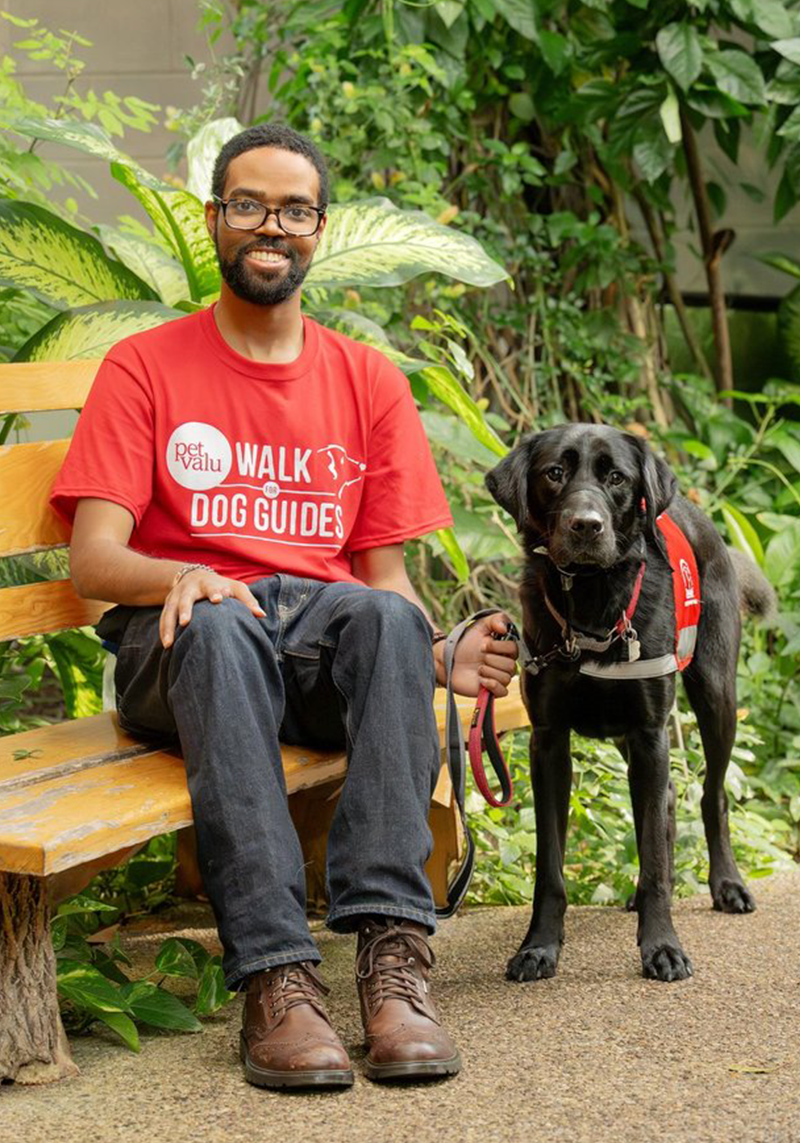
Seizure Response Dog Guides are trained to assist Canadians (14 years or older) diagnosed with intractable epilepsy through specific tasks. These Dog Guides are trained to bark in response to a seizure, go and get someone inside the home, fetch a medical kit or phone, and provide comfort during a recovery period.
“My name is Alex, and this is my Seizure Response Dog Guide, Jensen. We’ve been together for 10 months, and in that short time, he has become far more than a Dog Guide – he is my safety, my reassurance, and my constant companion.
When I was first diagnosed with epilepsy in 2007, the disability felt more like an irritation than anything else. At first, it was something I could push aside. However, as I got older, it quickly became a restriction, quietly shrinking my world – preventing me from travelling on my own, seeing my friends, and spending time by myself.
Having Jensen has given me the personal security and confidence to travel independently and visit friends. He gives me the freedom to say “yes” again. I can’t deny that I questioned my decision after I applied, wondering if I was asking for more than I needed. But after working at the Dog Guides training school with Jensen—and seeing him react to a seizure I had just one day after bringing him home – I knew I had made the right choice. In that moment, everything changed.
For many years, I either stayed home or took risky chances by going out alone. Both options came with fear. I truly believe that freedom and independence can make any day a little brighter, bringing light even into the long darkness of Canadian winters.
So, from Jensen and me, we walk because we believe disabilities should not stop people’s independence. Because everyone deserves the freedom to live fully, confidently, and without fear.”
- Alex with Seizure Response Dog Guide, Jensen
AUTISM ASSISTANCE
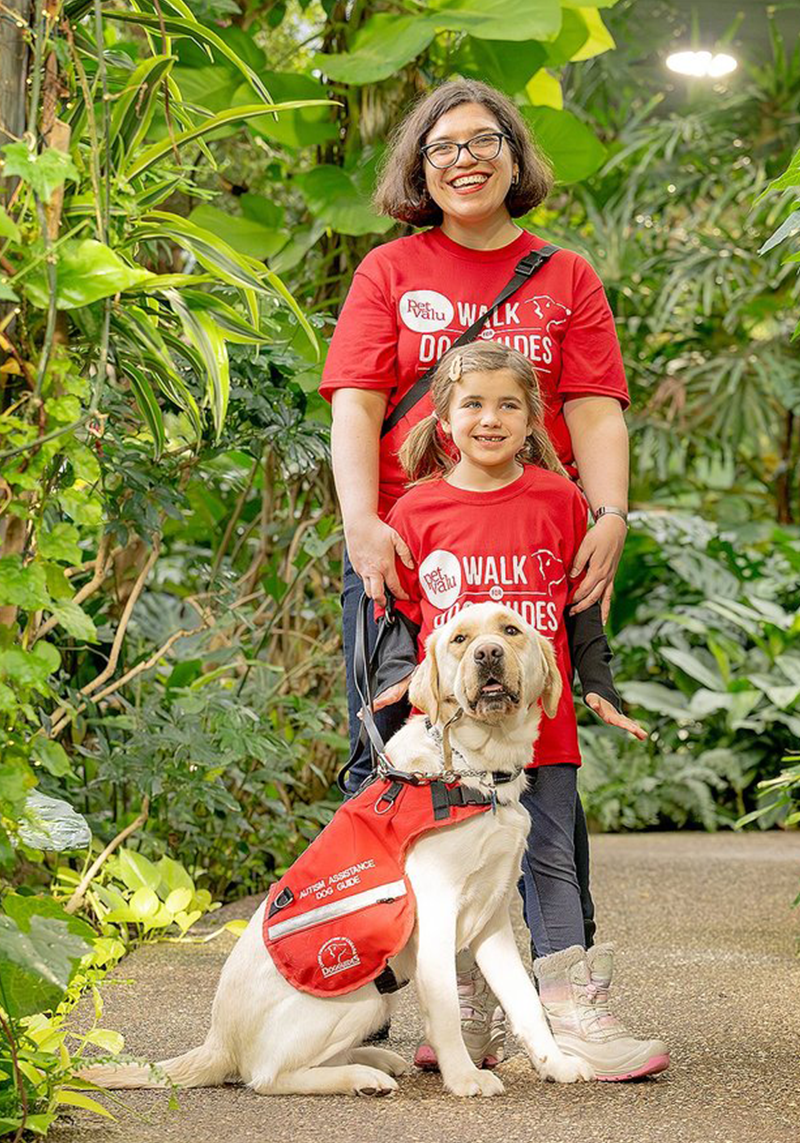
Autism Assistance Dog Guides assist children (ages 3-12) on the autism spectrum. These Dog Guides provide safety, companionship and unconditional love.
“My name is Sam, and my daughter Martha was diagnosed with autism at the age of 2. Over the last five years, our family has worked hard to help Martha gain the resources and skills she needs to thrive in her community. She is a bright and joyful child with a strong love of animals, and through the Lions Foundation of Canada Dog Guides, she was matched with her Autism Assistance Dog Guide, Binx. We were absolutely ecstatic when Binx officially became part of our family.
Our family welcomed Binx into our home last fall, and Martha quickly formed a bond with her new best friend. He is there to comfort her when she feels overwhelmed, helps her stay close to us as we navigate public spaces, and she has even learned to sleep through the night with Binx by her side. As Martha gains more confidence and independence, we look forward to her Dog Guide accompanying her to school and other activities.
We will be walking in the Pet Valu Walk for Dog Guides because we know the importance of this life-changing program and hope that more families can benefit from it. Thank you to everyone who has dedicated their time and resources to ensuring that kids like Martha never have to walk alone in this world. ”
– Sam, Martha’s mother, with Autism Assistance Dog Guide Binx
DIABETES ALERT
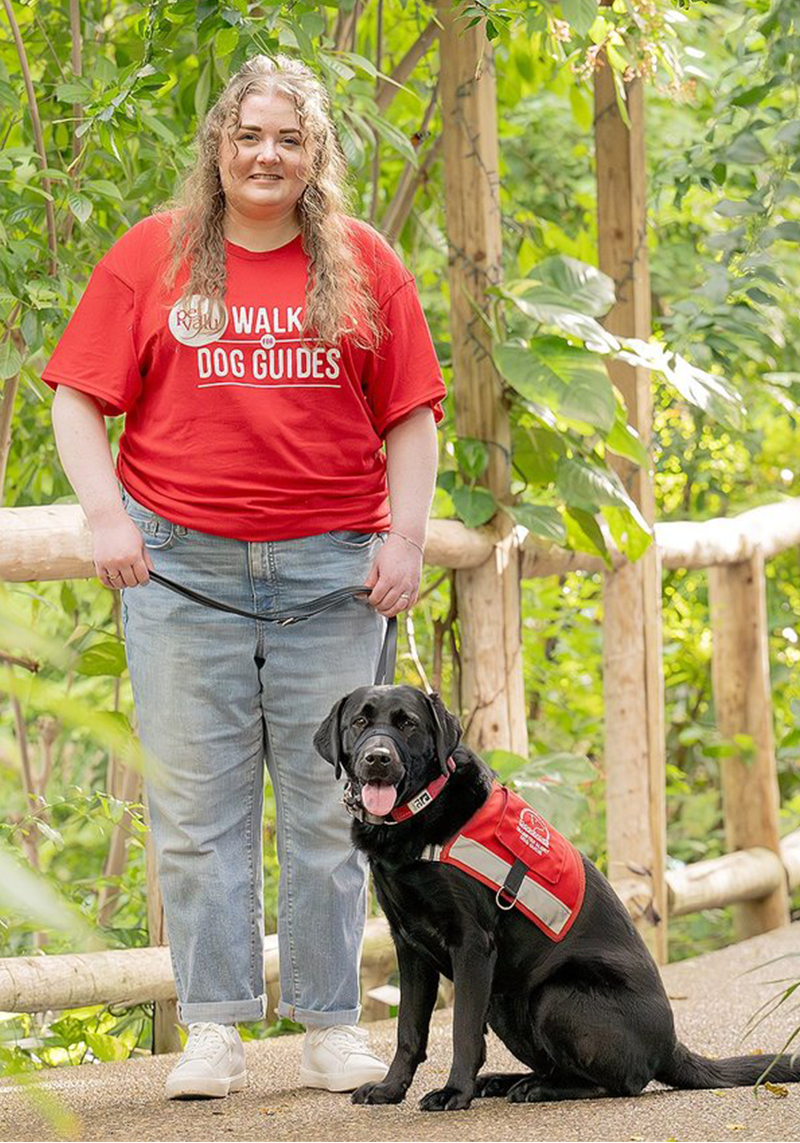
Diabetes Alert Dog Guides are trained to assist Canadians (14 years or older) diagnosed with Type 1 Diabetes (insulin dependent) by providing specific tasks and advanced scent work. These Dog Guides are trained to detect sudden drops in their handler’s blood sugar and alert them.
"My name is Natalie, and I am a 31-year-old Métis graphic designer and artist. I’ve been partnered with my Diabetes Alert Dog Guide, Phoebe, for over a year now, and for the first time in a long time, my independence feels truly restored.
I was diagnosed with type 1 diabetes at age 13, just three months after my younger sister, and since then I have learned that managing diabetes is a 24/7 job with no days off. It means constantly thinking about how everything you do will impact your blood sugar. From food to exercise to emotions, it all affects how your blood sugar reacts. People tend to think the pokes are the hard part, but I find that it’s the never-ending mental load, the constant juggling, and the unpredictability that make it so challenging.
Part of that juggling is dealing with low blood sugar. Around 2020, I started to lose the ability to feel when I was going low. That loss of awareness was terrifying. Being low is extremely dangerous, especially if you are by yourself.
Phoebe has played a huge role in allowing me to be independent and not have to rely on someone else to feel safe while doing everyday tasks. She gives me back something I didn’t realize I was missing – peace of mind. Things like shopping or taking a walk all feel safer because I have her with me.
The first time I walked to the mall alone and was able to run errands without someone with me is a moment that really sticks out. That simple trip felt monumental. I hadn’t realized how uneasy and stressed I felt when I was alone until I wasn’t – until I felt calm, confident, and capable again – because I had Phoebe by my side.
We walk in the Pet Valu Walk for Dog Guides because nobody should feel scared to go out because of their disability. Walking for Dog Guides means opening doors to independence, confidence, and safety – so others can live their lives fully, freely, and without fear."
– Natalie with Diabetes Alert Dog Guide, Phoebe
FACILITY SUPPORT
Facility Support dogs assist Canadian professional agencies working with vulnerable people who have experienced trauma which could be a result of criminal behavior. These dogs are specifically trained to provide a non-judgmental, attuned presence and calming influence to reassure a person experiencing a stressful situation.
“My name is Jennifer, and this is Zane. He has become a powerful source of comfort, connection, and support for the children and youth he serves.
I first heard about Facility Support Dog Guides in 2023 through a friend who was fostering at the Lions Foundation of Canada Dog Guides. My workplace, Pathstone Mental Health, was exploring innovative treatment approaches, and I immediately thought of Dog Guides. We were matched with Zane in June 2024, and he has become an invaluable member of our staff, beloved by our clients.
Pathstone Mental Health provides accessible counselling and support services for children and youth in the Niagara region, serving individuals up to 18 years old. A typical day at work begins with Zane taking a movement break before meeting clients, preparing him for his role as a Facility Support Dog Guide supporting children impacted by trauma. During the day, Zane meets with kids, offering comfort, guidance, and companionship that helps them feel safe and engaged in the therapeutic process.
We are currently collecting data for a research study with Brock University on animal-assisted therapy. A typical AAT (animal-assisted therapy) session with Zane begins with a walk and informal conversation to discuss updates or concerns. During therapy, Zane provides support by hugging clients, resting his head on them, or cuddling them – simple gestures that can mean everything to a child who is struggling to trust. We also incorporate dog training as a transferable concept for therapy, teaching skills like starting and stopping activities or practicing the “look” command, which clients can then apply to their own lives. Sessions often end with a game of “hide and go seek,” where Zane searches for the child, combining fun with learning.
Zane has helped clients improve school attendance by applying the skills they learn from him one step at a time. One memorable moment happened at the Pet Valu Walk for Dog Guides photoshoot in 2025. A child was upset that he couldn’t pet the other Dog Guides, and Zane went over to him unprompted and assumed his rest posture. Without a word, Zane helped regulate the child’s emotions – demonstrating empathy, awareness, and care beyond what anyone expected. This helped regulate the child and impressed the adults with Zane’s skills.
We walk in the Pet Valu Walk for Dog Guides because we believe in the power of moving forward—one step at a time—and in the hope, comfort, and unconditional acceptance Zane brings to everyone he meets. Through him, we see lives calming, confidence growing, and healing beginning.”
-Jennifer and Zane, Facility Support team


